
Review · DAY TRIPS FROM BRUSSELS
From Brussels: Bruges and Ghent Full-Day Trip by Train
Bruges gives you canals, brick guildhalls, and a medieval center that feels almost too tidy to be real. Ghent answers with a bigger, more lived-in old town, grand churches, the old port of Graslei, and the imposing Castle of Gravensteen. Seeing both by train in one day is a smart way to cover Flanders from Brussels.
I like the train-based transport, which avoids the bother of arranging separate connections, and I like the guide-led walk through places that can seem confusing on a first visit. Guides such as Louisa have been praised for their humor, patience, and strong knowledge of the cities. The tradeoff is clear: 10 hours is a lot of walking, and you will get an overview rather than enough time for museums, boat rides, or slow café wandering.
Key points to know before booking
- Two major Flemish cities in one day: Bruges comes first, followed by Ghent, with train travel from Brussels included.
- A long walking day: Uneven streets, several historic districts, and a fast schedule make comfortable shoes essential.
- Bruges includes about two and a half hours with the guide: You then get roughly two hours for food, shopping, photos, or a canal boat.
- Ghent brings the larger medieval setting: Graslei, Saint Bavo Cathedral, several old churches, and Gravensteen fill the second half of the day.
- Optional extras cost extra: The Bruges boat trip is €8, and the Van Eyck altarpiece in Ghent costs €4.
- Sunday departure only: The meeting details list 8:30 AM at Brussels Grand Place, while another part of the schedule says departure at 9:30 AM, so confirm the exact time before you go.
Two medieval cities, one long day
This outing is built for the person who wants to see the headline sights of Bruges and Ghent without changing hotels or figuring out Belgian trains alone. At $82 per person, the price covers the guide and transport from Brussels to both cities. That is fair value if you want structure, historical context, and a simple return to Brussels.
The cost does not cover lunch, the Bruges canal boat, or the optional visit to The Adoration of the Mystic Lamb. Those extras are not essential, but they can add up. You should also think of this as an orientation day. To explore both cities at a relaxed pace, you would need much longer.
The tour is offered in English, French, or Spanish. It is listed as wheelchair accessible, though the warning about uneven surfaces and extensive walking is important. If you have limited mobility, check how much of the route can be adjusted before booking.
The published timing contains a small conflict. The meeting point is given as 8:30 AM in front of the Tourist Information Office at Grand Place, with a guide carrying a white umbrella. Another part says departure is at 9:30 AM. I would use 8:30 AM as the safer arrival time and confirm the final departure time with your booking details.
More Train Day Trips in Belgium:
- From Brussels: Bruges Full-Day Trip by Train
★ 4.5 · 232 reviews - From Milan: Bernina Train and St. Moritz Day Trip
★ 4.5 · 4,495 reviews - Salzburg Sightseeing Day Trip from Munich by Rail
★ 4.5 · 3,125 reviews
Bruges begins with canals and the Lake of Love
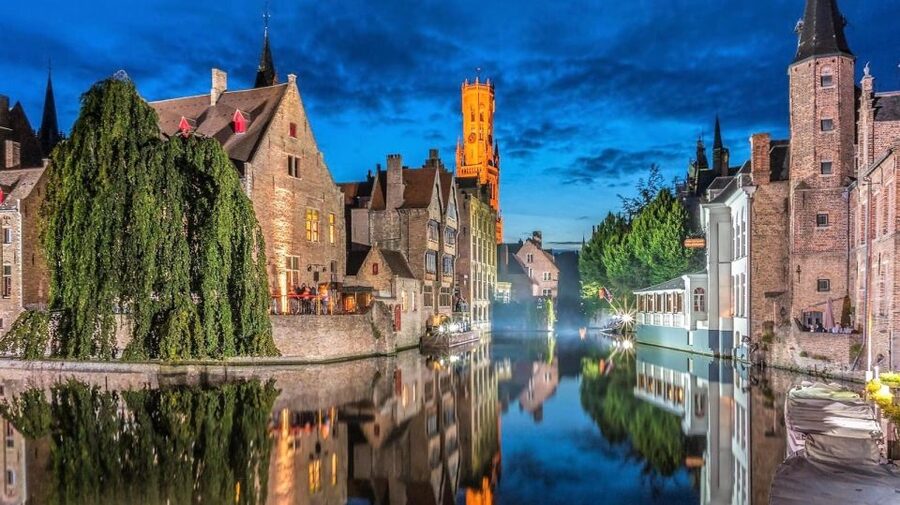
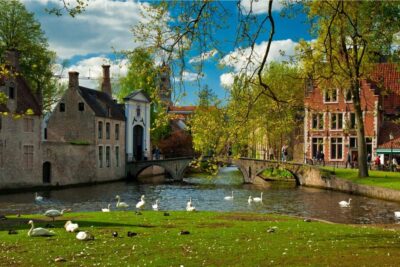
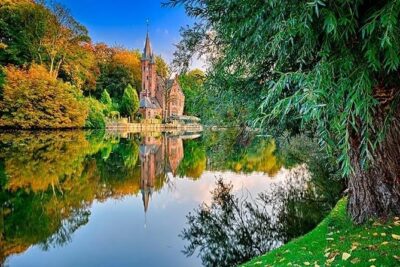
After arriving at Bruges Central Station, the guided walk moves into the old city. The first stretch includes the Lake of Love, a water reservoir within the former city walls. It is a calm introduction to Bruges, where water, narrow streets, and old brick buildings work together to create the city’s famous look.
You then reach the Beguinage, one of the best-preserved medieval gated communities in Europe. Women lived here in a religious community, but it was not a conventional convent. The enclosed setting helps explain how urban life was organized centuries ago, and it is one of the quieter stops on a busy sightseeing route.
The walk also passes Brewery De Halve Maan, the only brewery still operating in Bruges city center. This is a useful detail for beer fans because Belgian brewing is not just a souvenir theme here. The brewery remains part of the city’s working life.
Churches, art, and old squares in Bruges
Old St. John’s Hospital is one of Bruges’ most atmospheric buildings. Its long history as a hospital is visible in the architecture, which covers about 800 years of European building styles. The museum devoted to Hans Memling is optional, so you should not assume you will have time for a full museum visit during the main walk.
The route continues to the Church of Our Lady. Its brick tower is one of the tallest of its kind in the world, and the church contains major works of art, including Michelangelo’s Madonna with the Child. The artwork is an optional visit, so the schedule may favor seeing the exterior and key points inside rather than lingering.
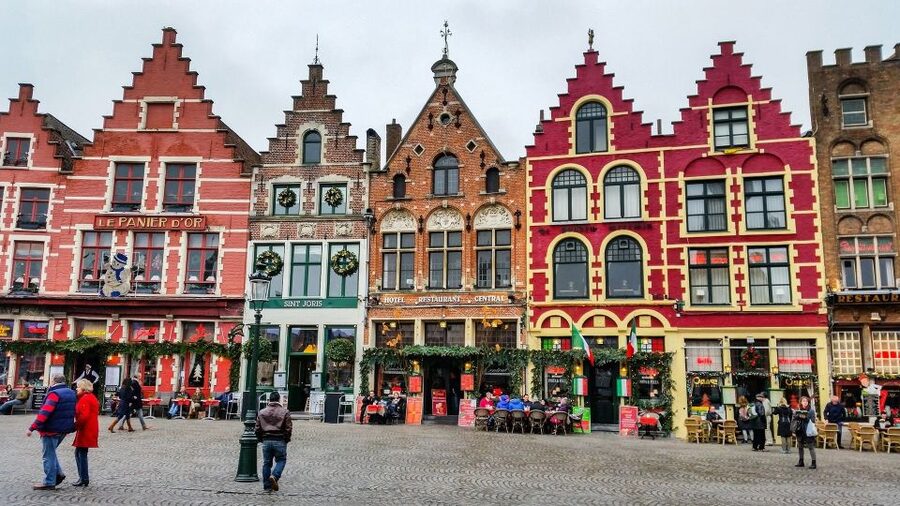
VisMarkt, the old fish market, and Tanners’ Square show a more intimate side of Bruges. Guildhalls line the spaces, while cafés and restaurants offer places to pause. These squares are good reminders that Bruges was not built as a picture set. They were working commercial spaces tied to trade, food, and craft.
You also pass the Groeninge Museum, Burg Square, and Markt Square. Burg is the civic and religious center, while Markt was the economic heart of the city. At Markt, look up at the guildhalls and Belfort tower. The Gothic bell tower is one of Belgium’s best-known landmarks, and it gives the square much of its character.
Your free time in Bruges
The guided portion lasts about two and a half hours, followed by about two hours of free time. This is the point where you choose what matters most.
You can use the break for lunch, Belgian chocolates, souvenirs, or a canal boat. The boat trip costs €8 and is paid when you board. It is one of the best ways to understand Bruges because the narrow waterways show the backs of buildings, small bridges, and views that are easy to miss on foot.
The catch is time. A boat ride, lunch, and shopping can quickly consume the entire break. You are unlikely to fit in the boat, a museum, a horse ride, and a leisurely meal. One of the most useful ways to handle Bruges is to pick one priority before the free period begins.
For food, the famous local choices include moules frites, Belgian beer, and chocolate. The tour does not include a meal or tasting, so you choose where and how much to spend. If you want a sit-down lunch, keep an eye on the meeting time. Missing the group would be a serious problem on a day built around train connections.
More Full-Day Escapes in Belgium:
- From Brussels: Flanders Fields Remembrance Full-Day Trip
★ 4.4 · 65 reviews - From Bruges: Flanders Fields Remembrance Full-Day Trip
★ 4.8 · 65 reviews - From Munich: Neuschwanstein & Linderhof Castle Full-Day Trip
★ 4.6 · 14,646 reviews - From Marrakesh: Essaouira Full-Day Trip
★ 4.6 · 8,137 reviews
Ghent brings a bigger medieval setting
From Bruges, the group continues by train to Ghent, a port city where the Leie and Scheldt Rivers meet. Ghent feels different from Bruges. It has the same medieval bones, but its scale is larger and its streets have a more urban feel.
Saint Bavo Cathedral is the main opening stop. The Gothic church contains Baroque decoration, a marble choir, private chapels, and a Rococo pulpit. The Romanesque crypt adds another layer, with frescoes that reach back much further than the grander parts of the building.
The optional highlight here is The Adoration of the Mystic Lamb by Hubert and Jan van Eyck. It is one of the great works of medieval European art. Entry costs €4, and the schedule may not allow unlimited time. If this altarpiece is a main reason you want to visit Ghent, ask the guide how the timing works before deciding how to spend your free moments.
The cathedral visit is valuable even if you skip the extra artwork. You get a clear look at how different periods added to the same building, from the Romanesque crypt to Gothic structure and later Baroque and Rococo details.
City Hall, Belfort, and Ghent’s old churches
The route continues to City Hall, where Gothic, Renaissance, and Baroque architecture appear in one complex. It is a good stop for seeing how Ghent changed over time without losing its medieval center.
At the Market Hall, you can look toward the Belfort Tower and the covered market. The tower is part of Ghent’s famous group of medieval towers, and its position helps you understand the shape of the historic center.
The nearby churches of Saint Nicholas, Saint James, and Saint Michael add to the sense of a dense old city built around faith, trade, and civic power. You will not have enough time to study every church in detail, but the guided route gives you a useful framework for deciding what deserves a return visit.
This part of the tour can feel rushed if you want to enter every building. That is the unavoidable cost of seeing two cities in one day. The guide’s job is to point out what matters and keep the group moving.
Graslei and Castle of Gravensteen
Graslei is one of Ghent’s most memorable views. The old port runs along the Leie, with historic guildhalls facing the water. This is a good place to stop for photographs, but it also explains Ghent’s strength as a medieval trading city.
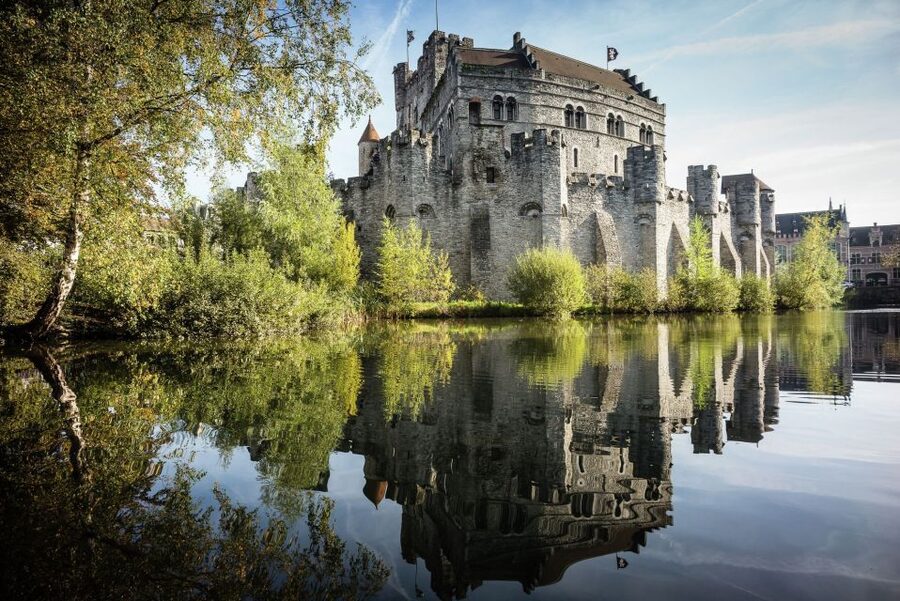
The Castle of Gravensteen provides the day’s strongest fortress scene. The Counts of Flanders once lived here, and its stone walls make a sharp contrast with the elegant facades along the river. The tour takes you to the castle, but the available information does not promise a full interior visit. If entering the castle is important to you, confirm whether the schedule allows it.
The route then passes through Patershol, a picturesque district with brick facades, restaurants, and cafés. It is one of the better places to get a sense of Flemish food culture. The final major stop is the 15th-century Great Butchers’ Hall, one of Europe’s oldest meat markets.
Together, these stops show Ghent’s different sides: religious, commercial, defensive, residential, and culinary. You get more than a string of postcard views.
The guide can make or break the pace
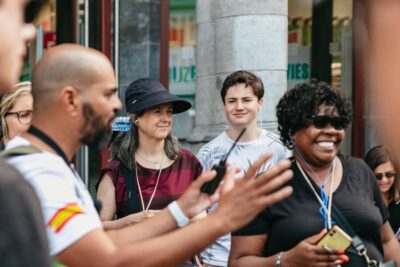
The strongest part of this experience is the human guide. Several guides have led the outing, and Louisa received especially warm praise for her humor, patience, and ability to keep a mixed group engaged. She was also noted for making frequent photo stops and helping families with children.
That does not mean every departure will have Louisa. The guide may speak English, French, or Spanish, and bilingual delivery can slow the pace. One English and French group found that switching between languages took extra time. If you understand only one tour language, ask how the language arrangement will work.
Group discipline also matters. A guide can give a much better tour when everyone stays together. The route covers two cities, so a person who repeatedly wanders off can delay the whole group.
The meeting point is in front of the Tourist Information Office at Grand Place. Look for the white umbrella, but arrive early because the start-time information is not perfectly consistent.
Is $82 a fair price?
For $82, you receive a full day of guidance and round-trip transport from Brussels. That makes the cost reasonable for a first visit, especially if you would otherwise need to arrange separate train journeys, learn the city routes, and keep track of return times.
The value is lower if you want freedom. Your time is divided between a guided route, a fixed train schedule, and a short free period in Bruges. You pay extra for the boat and Van Eyck altarpiece, and food is separate.
I see this as a good purchase for convenience and context, not for deep exploration. A self-guided visit could cost less, but it would not give you the same overview in one day. In a small group, you may have the option of returning with the guide at the planned time or staying longer and making your own way back later. That flexibility is useful, but only when offered for your specific departure.
Free cancellation is available up to 24 hours before the activity, and you can reserve now and pay later. Those terms help if your Brussels plans are still shifting.
Who should book this day trip?
I would choose this tour if you are based in Brussels, have only one open day, and want to see the two most important medieval cities in Flanders. It also suits you if train travel feels unfamiliar or if you want historical explanation rather than a list of places to photograph.
Families can manage it, but children need stamina. The tour covers a lot of ground, and the streets are not always smooth. Comfortable shoes are not a polite suggestion here. They are the difference between enjoying the final hour and counting the minutes until the train.
I would not choose it if your main goal is museum time, long meals, or a slow canal day. Bruges and Ghent deserve a day each when you want to see interiors, take a boat, shop, and stop whenever a square catches your eye.
Should you book it?
Book it if you want a well-organized introduction to Bruges and Ghent and accept a brisk pace. The guide, train connections, and route remove much of the planning work, while the combination of canals, churches, guildhalls, a castle, and Belgian food gives you a strong first look at Flanders.
Skip it if you prefer unhurried visits or already know you want several museums and paid sights. Before booking, confirm the Sunday meeting time, choose your priority for Bruges free time, and budget another €8 for the boat and €4 for the Van Eyck altarpiece if those appeal to you.
FAQ
Where does the tour meet in Brussels?
The meeting point is at Grand Place, in front of the Tourist Information Office. Look for a guide holding a white umbrella.
What time should I arrive?
The meeting information lists 8:30 AM, while another schedule detail gives a 9:30 AM departure. Arrive according to the confirmed time on your booking, and use 8:30 AM as the safer planning time unless the provider tells you otherwise.
How long does the tour last?
The activity lasts 10 hours. The planned return to Brussels is at 5:00 PM, with arrival around 6:00 PM.
Is the tour offered every day?
The departure information specifies Sunday only.
Which languages are available?
The live guide may conduct the tour in English, French, or Spanish.
Is train transport included?
Yes. Transportation from and back to Brussels is included, with the route traveling to Bruges and Ghent by train.
Is the Bruges canal boat included?
No. The optional boat trip costs €8 per person and is paid when you board.
Is entry to The Adoration of the Mystic Lamb included?
No. The optional Van Eyck altarpiece visit costs €4.
How much walking should I expect?
You should expect a lot of walking on uneven historic streets. Comfortable shoes are essential.
Can I stay longer in Bruges?
For small groups, there may be an option to return with the guide at the planned time or stay longer and return later by yourself. Confirm whether this option applies to your departure.
Just written up around Belgium
- From Brussels: Flanders Fields Remembrance Full-Day Trip★ 4.4 · 65 reviews
- From Paris: Day Trip to the Enchanting Brussels and Bruges★ 4.2 · 323 reviews
- From Brussels: Day Trip to Ghent with Atomium★ 4.7 · 192 reviews
- From Bruges: Flanders Fields Remembrance Full-Day Trip★ 4.8 · 65 reviews
- From Brussels: Bruges Full-Day Trip by Train★ 4.5 · 232 reviews
- From Brussels: Day Trip to Ghent with Atomium in English★ 4.5 · 88 reviews
- From Amsterdam: Day Trip to the Charming Brussels and Bruges★ 4.6 · 264 reviews
- From Amsterdam: Day Trip to Bruges in Spanish or English★ 4.6 · 357 reviews
Day Trips from Brussels, side by side.
Lists this day trip turns up in