Review · DAY TRIPS FROM ROME
Ancient Ostia Antica Semi-Private Day Trip from Rome by Train with Guide
Ostia Antica gives you something Rome’s famous monuments rarely can: a chance to walk through an entire ancient city. You’ll follow the Decumanus Maximus, sit in a 3,500-seat amphitheater, and see the Baths of Neptune’s striking sea-god mosaic without spending a full day getting to Pompeii.
I like the simple train connection and the fact that tickets are handled for you. I also like the small group, capped at 12, which makes it easier to hear stories about Roman shops, apartments, baths, and daily routines. The main drawback is the walking: uneven ground, stairs, heat, and a fairly brisk pace can be difficult if you have limited mobility.
Key points at a glance
- An entire Roman port city: See streets, taverns, public baths, temples, shops, apartments, and an amphitheater rather than just one isolated monument.
- Easy rail outing from Rome: Meet near Piramide metro station, ride with your guide, and return to the same meeting point by train.
- A focused 2.5-hour walk: Your guide leads you to major sights instead of leaving you to find your way across a very large archaeological park.
- Small group size: No more than 12 people means better access to the guide and less crowding around explanations.
- Strong guide reports: Alberto, Barbara, Cat, Laura, Rob, Roberto, Alfredo, and others are praised for clear explanations, patience, humor, and care in hot weather.
- Good value at $59.26: The price includes the round-trip train ride, archaeological site admission, and English-speaking guide.
Why Ostia Antica deserves time away from central Rome
Ostia Antica was ancient Rome’s port city. At its height, it was home to more than 100,000 people, and the ruins let you see how ordinary Romans lived, worked, worshipped, bathed, and entertained themselves.
That is the chief appeal. Rome’s center gives you grand temples, imperial forums, and famous monuments. Ostia gives you the daily machinery of a city. You walk past small commercial spaces, living quarters, public buildings, and bathing complexes. The result feels less like a collection of heroic ruins and more like a town abandoned in place.
The site is often compared with Pompeii, but that comparison needs care. Ostia Antica is not Pompeii, and this tour does not take you there. Still, it offers a similar pleasure on a much easier half-day outing from Rome. Several people use Ostia as their answer to the problem of having no time for Pompeii.
I especially like the lower-key atmosphere. The archaeological park is large, and parts of it can feel peaceful rather than packed. That gives you room to look closely at mosaics, street layouts, and building details. It also makes the explanations easier to follow than they can be at Rome’s busiest monuments.
More Private Day Trips in Italy
- Private Tour: Pompeii and Positano Day Trip from Rome
★ 4.5 · 74 reviews - Private Tour: Day Trip to Florence and Pisa from Rome with Lunch
★ 4.0 · 65 reviews - Private Day Trip Rome to Pompeii & Amalfi Coast tickets included
★ 5.0 · 61 reviews
Meeting near Piramide and taking the train
The meeting point is at P.za Ostiense, 11, near the Piramide metro station. You do not get hotel pickup, so allow enough time to reach the starting point and read the meeting instructions carefully.
Your guide provides the train tickets before you board. The group then takes the train southwest from Rome toward Ostia Antica. This is one of the tour’s practical strengths. You do not have to work out the route, buy the correct tickets, or figure out where to regroup at the archaeological site.
The ride is part of the outing, not merely a transfer. You see a bit of Rome beyond the historic center and get a natural transition from modern city to ancient port town. The tour ends back at the original meeting point after the return train ride.
The full experience lasts about four hours. The archaeological site portion takes roughly two and a half hours, with the remaining time covering the meeting, rail journey, and walk between the station and ruins. Since trains and outside conditions can affect the schedule, keep a little flexibility in your day.
Following the Decumanus Maximus into ancient Ostia
Once inside, the guide leads you along the Decumanus Maximus, the city’s principal street. This is a useful beginning because it gives you the basic shape of Ostia before you move into individual buildings.
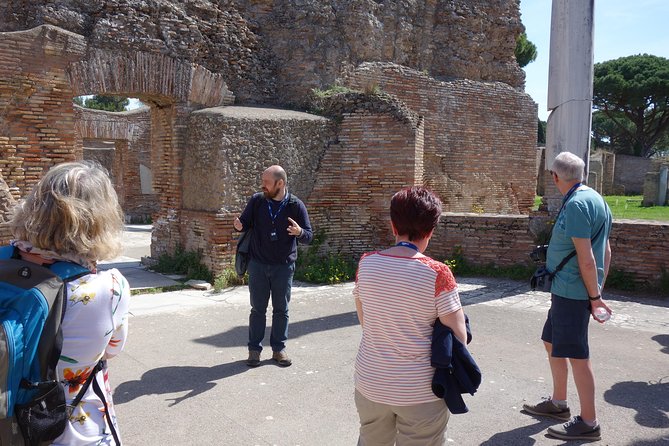
Rather than treating each ruin as a separate puzzle, a good guide connects the street to the people who used it. You begin to understand how goods, workers, families, officials, and worshippers moved through the city. The best guides make the stones easier to read by explaining what a doorway, shop front, courtyard, or public building likely meant in daily life.
The walking route is not a quick photo stop. You will spend time moving between several areas, and the guide may pause at selected points to explain the city’s purpose and growth. This is where the tour adds value over simply taking the train and buying entry on your own.
At the same time, Ostia Antica is a large site. Two and a half hours cannot cover every lane, building, or museum display. The tour is designed to show the main sights and provide a framework, not to give you an exhaustive archaeological study.
The Baths of Neptune and Roman public life
The Baths of Neptune are one of the major stops. Their centerpiece is a mosaic showing Neptune, the Roman god of the sea, riding a four-horse chariot. It is a memorable image in a city tied so closely to maritime trade.
The baths also help explain how Roman public life worked. A bathing complex was not simply a place to wash. It was part of the social structure of the city, and the buildings reveal the scale and care devoted to public facilities.
Your guide’s explanation matters here. Without context, you might see a floor, a wall, and a mosaic. With context, you can connect the decoration to the city’s port identity and to the role of shared public spaces. Guides such as Alberto, Barbara, Cat, and Rob have been particularly well regarded for making these connections clear without burying the group in technical detail.
The site has little shade in some areas, so hot weather can change the experience. Rob and Alfredo have been praised for choosing shady places for explanations and reminding people where they could refill water bottles. Even so, bring water, wear practical shoes, and expect sun exposure.
Same base, a different day out:
- From Rome: Pompeii, Amalfi Coast, and Sorrento Day Trip
★ 4.6 · 7,031 reviews - From Rome: Pompeii, Amalfi Coast and Positano Day Trip
★ 4.6 · 6,620 reviews - Pompeii, Amalfi Coast and Positano Day Trip from Rome
★ 4.5 · 6,250 reviews - Pompeii and Mount Vesuvius Day Trip from Rome with Pizza Lunch
★ 4.5 · 6,151 reviews
The amphitheater, temples, and Forum of the Corporations
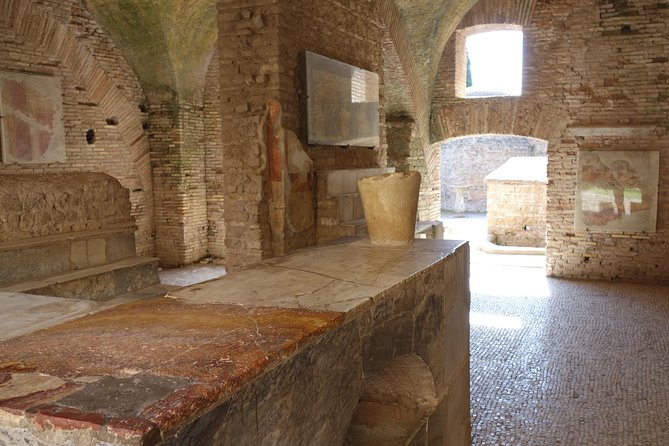
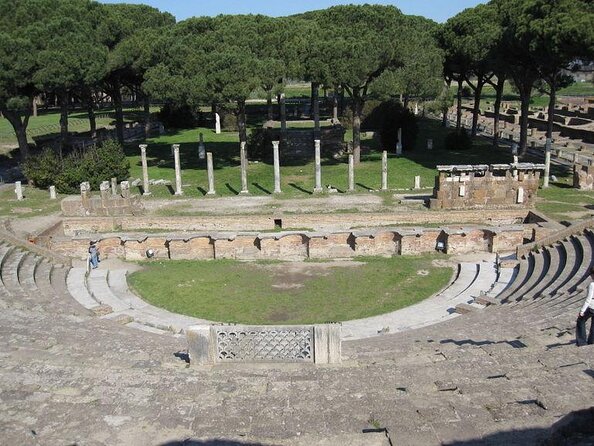
Ostia’s amphitheater dates to 12 BC and held about 3,500 spectators. You can take a seat and look across the structure, which gives you a direct sense of its size and purpose.
It is a pleasant place to pause because the building is easy to understand at a glance. You can see where the audience gathered and imagine the role of public entertainment in Roman city life. The amphitheater also offers one of the clearest moments for photographs during the walk.
The Forum of the Corporations adds another side of Ostia. Here, the city’s commercial character comes into focus. The port served Rome, and the remains point toward the businesses and trade networks that supported the capital.
The Collegiate Temple and other religious structures remind you that this was not only a commercial settlement. It was a functioning city with civic, religious, domestic, and recreational spaces. That mixture is what makes Ostia so useful for understanding Roman life beyond emperors and battlefields.
Shops, apartments, and the details of ordinary life
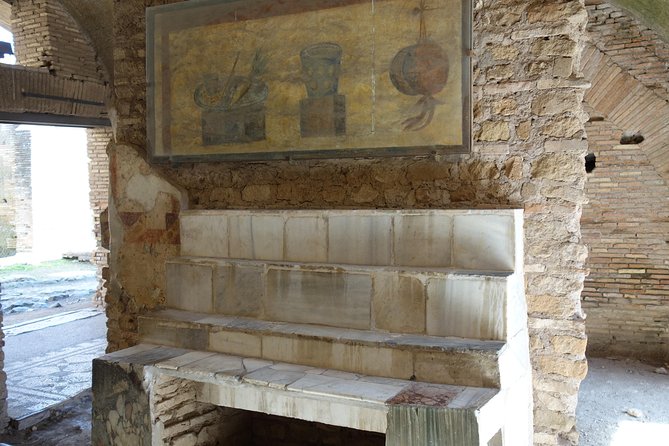
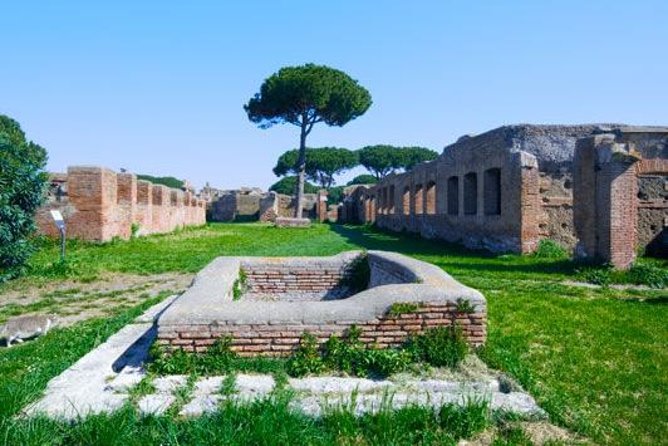
The smaller ruins may be the most rewarding part of the visit. You pass old shops and apartments, and these spaces help turn a distant period into something more familiar.
Look for the practical layout of the buildings. Commercial rooms open toward streets, while residential areas show how people occupied the city behind those public-facing spaces. A guide can point out how the arrangement of rooms and entrances suggests different uses.
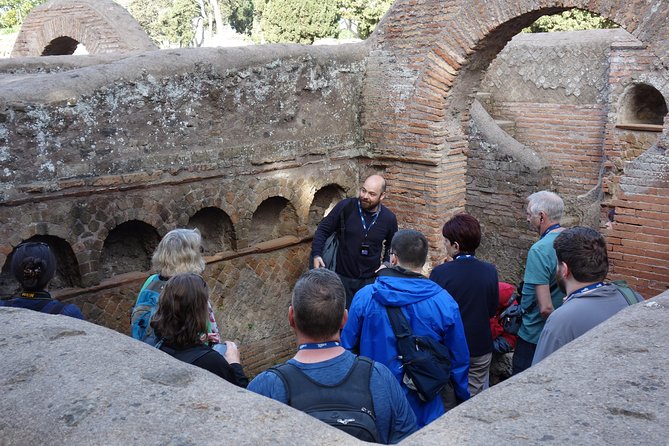
This is where the tour’s storytelling style can make or break the morning. Alberto has been praised for explaining buildings clearly, adding humor, keeping the group moving, and allowing enough time for questions. Barbara has been described as warm and engaging, while Cat is praised for combining friendly delivery with strong knowledge of the site. Laura Luongo has also received praise for adjusting the pace and helping the group through busy patches.
Those names are not a guarantee that you will receive a particular guide. They do show the sort of guide this experience needs: someone who can explain archaeology in plain language, manage a small group, and connect ruins to human behavior.
What the small group changes
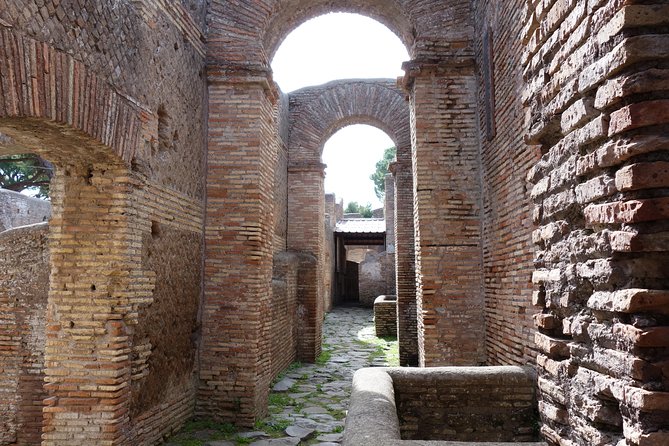
The maximum group size is 12. That is not private touring, but it is much more manageable than a large coach group.
You are more likely to hear the guide without standing at the edge of a crowd. Questions are easier to ask, and the guide can keep an eye on the group while crossing streets, climbing steps, or moving through narrow areas.
A small group also helps with the pace. Some people want dates and construction details. Others want to understand how families lived. The better guides balance both interests. Roberto has been praised for explaining the town, shops, and archaeological work while keeping the visit moving.
There is still a group pace. If you want to stop at every mosaic, read every sign, or spend a long time in the museum, you may feel rushed. One useful feature is that some guides give you the choice to leave with the group after the main walk or continue exploring on your own. Confirm this with your guide on the day, since the exact arrangement can vary.
Walking conditions and who should book
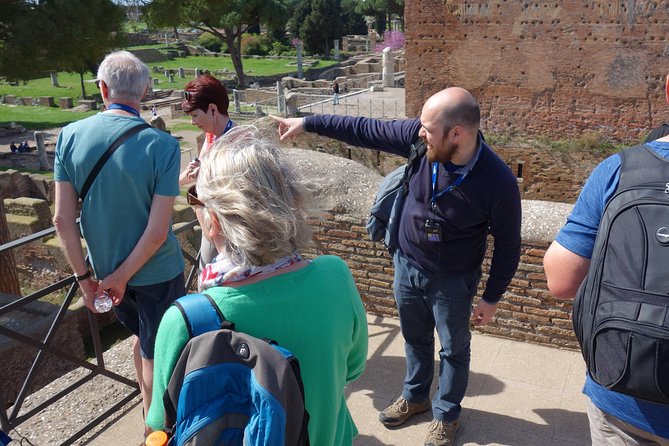
You need moderate physical fitness for this outing. The site includes uneven ground and stairs, and you will be walking for about two and a half hours. Getting on and off the train adds another physical element.
If you use a cane, have knee trouble, or need a slower pace, contact the operator before booking and explain your needs. One report describes a guide moving ahead of a guest with a mobility problem, which made the visit frustrating. That experience is worth taking seriously. A guide may be excellent with history and still not be the right fit if the pace does not match your abilities.
The tour suits adults, older children, and teenagers who can handle a long outdoor walk. One guide helped keep a child interested by making the history accessible. If your family is unsure about archaeology, Ostia’s streets, shops, and amphitheater offer more variety than a visit focused on one monumental building.
Wear comfortable shoes and plan for heat. The tour requires good weather, and a weather cancellation can result in another date or a full refund. Free cancellation is available up to 24 hours before the start time. Changes or cancellations inside that window are not refunded.
Is $59.26 a fair price?
At $59.26 per person, the price includes the English-speaking guide, round-trip train tickets, and entrance to Ostia Antica. That makes the cost easy to understand, with fewer add-on expenses once you arrive.
You can reach the site independently, so the tour is not the cheapest possible way to see Ostia. The extra money pays for transport coordination, admission, a planned route, and interpretation. For a first visit, I think that is fair value, especially because the ruins cover such a large area.
The value depends heavily on your guide. A strong guide can show you what you are looking at and explain why it matters. A flat or poorly paced guide may leave you wishing you had taken the train alone and used an audio guide. The experience has an overall rating of 4.7 out of 5 from 579 ratings, with 95 percent recommending it, but the uneven comments about guide style are a useful warning.
If you already know Roman archaeology well, you may prefer independent exploration. If you want the site to make sense without spending hours preparing, the included guiding is the main reason to book.
Ostia Antica compared with Pompeii
Pompeii remains the bigger name, but it requires a much longer outing from Rome. Ostia Antica is a practical substitute when your schedule is tight.
You will not get the same volcanic disaster story or the same scale of preserved domestic decoration. You do get a closer look at the workings of a Roman port city, and you can make the trip in about half a day.
Several families use the shorter visit to keep teenagers engaged. One useful idea is to continue toward the coast after the tour if your schedule allows, since the rail line can take you toward the beach. That is not part of the included activity, so treat it as a separate plan and check your timing.
Should you book the Ostia Antica train tour?
Book it if you want to understand ordinary Roman city life, prefer a half-day outing, and would rather have a guide select the key buildings than navigate the whole park alone.
It is especially good for first-time visitors, families with older children, and anyone who finds central Rome’s crowds tiring. Alberto, Barbara, Cat, Laura, Rob, Roberto, Alfredo, and Caterina are among the guides praised for clear explanations, friendly group management, and practical care. You cannot request a particular guide with certainty, but the strongest experiences show what the tour can deliver.
Skip it if you have serious mobility limits, dislike walking on uneven ground, or want complete freedom to explore every corner. In that case, independent entry with an audio guide may suit you better.
For most people with one free morning or afternoon, I would book it. Ostia Antica is close enough to Rome to be easy, large enough to feel substantial, and varied enough to keep the ancient world from becoming a row of identical stones.
FAQ
How long does the Ostia Antica tour last?
The experience lasts approximately four hours, including the train journey from Rome, the guided visit, and the return trip.
Where does the tour begin?
It begins at P.za Ostiense, 11, 00154 Roma RM, near the Piramide metro station.
Where does the tour end?
The activity ends back at the original meeting point in Rome.
Is transportation included?
Yes. The guide provides train tickets for the journey to Ostia Antica and the return trip to Rome.
Is the entrance fee included?
Yes. The Ancient Ostia entrance ticket is included in the price.
How large is the group?
The tour has a maximum of 12 people.
Is the tour offered in English?
Yes. An English-speaking guide leads the experience.
How much walking is involved?
The guided visit lasts about 2.5 hours and requires moderate physical fitness. Expect uneven ground, stairs, and transfers on and off the train.
Can I cancel for a full refund?
Yes, if you cancel at least 24 hours before the experience begins. Cancellations or changes made less than 24 hours in advance are not refunded. If poor weather or an insufficient number of bookings causes cancellation, you will be offered another date or a full refund.
More Train Day Trips in Rome
- From Rome: Positano & Amalfi Coast Day Trip by Train & Ferry
★ 4.6 · 225 reviews - From Rome: Day Trip to Florence by High-Speed Train
★ 4.7 · 44 reviews
More Train Day Trips in Italy
- From Rome: Ostia Antica Guided Half-Day Trip by Train
★ 4.8 · 486 reviews - Venice Day Trip from Rome by High-Speed Train with Happy Hour
★ 4.5 · 445 reviews - From Rome: Day Trip to Venice by High-Speed Train
★ 4.6 · 352 reviews - From Rome: Pompeii and Naples Day Trip by High-Speed Train
★ 4.7 · 234 reviews
Just written up around Rome
- Day trip Rome by car : Tivoli Unesco Villa D’este & Hadrian★ 5.0 · 56 reviews
- From Rome: Hadrian’s Villa & Villa d’Este Day Trip & Lunch★ 4.5 · 157 reviews
- Sorrento & Pompeii Day Trip from Rome Audio Guide Tour★ 4.2 · 50 reviews
- Day Trip from Rome: Explore Pompeii & Sorrento Amalfi Coast★ 4.8 · 160 reviews
- From Rome: Positano & Amalfi Coast Day Trip by Train & Ferry★ 4.6 · 225 reviews
- From Rome: Ponza Island Day Trip with Boat Excursion★ 4.7 · 278 reviews
- From Rome: Pompeii and Vesuvio Guided Day Trip with Lunch★ 4.3 · 126 reviews
- From Rome: Positano, Amalfi Coast and Sorrento Day Trip★ 4.5 · 509 reviews
Day Trips from Rome, side by side.


Pompeii, Amalfi Coast and Positano Day Trip from Rome
Read our review →
Pompeii and Mount Vesuvius Day Trip from Rome with Pizza Lunch
Read our review →
Tuscany & Montepulciano Day Trip with Lunch & Wine Tasting
Read our review →
Pompeii Day Trip with Optional Vesuvius and Lunch
Read our review →
Amalfi Coast & Positano Day Trip with Coastal Cruise
Read our review →